✓
No Minimum Order
✓
Friendly Service
✓ Fast Nationwide Delivery
You wouldn't build a high-spec HVAC frame just to watch it rattle itself to pieces within six months. It sounds like a bit of an exaggeration, but for anyone working near heavy plant machinery or exposed coastal sites, the constant hum of vibration is a slow-motion disaster for standard fasteners.
That's where stainless steel nyloc nuts come in; they aren't just another bit of hardware, but a permanent insurance policy for your installation.
We all know the headache of returning to a job site just to tighten a few loose bolts that couldn't handle the shakes. You want a support system that stays put without needing a monthly inspection.
This guide shows you exactly how to achieve that "set and forget" reliability whilst using the right grade of hardware. We'll break down the practical differences between A2 and A4 grades and help you pick the M10 or M12 parts that actually match the lifespan of your strut channel.
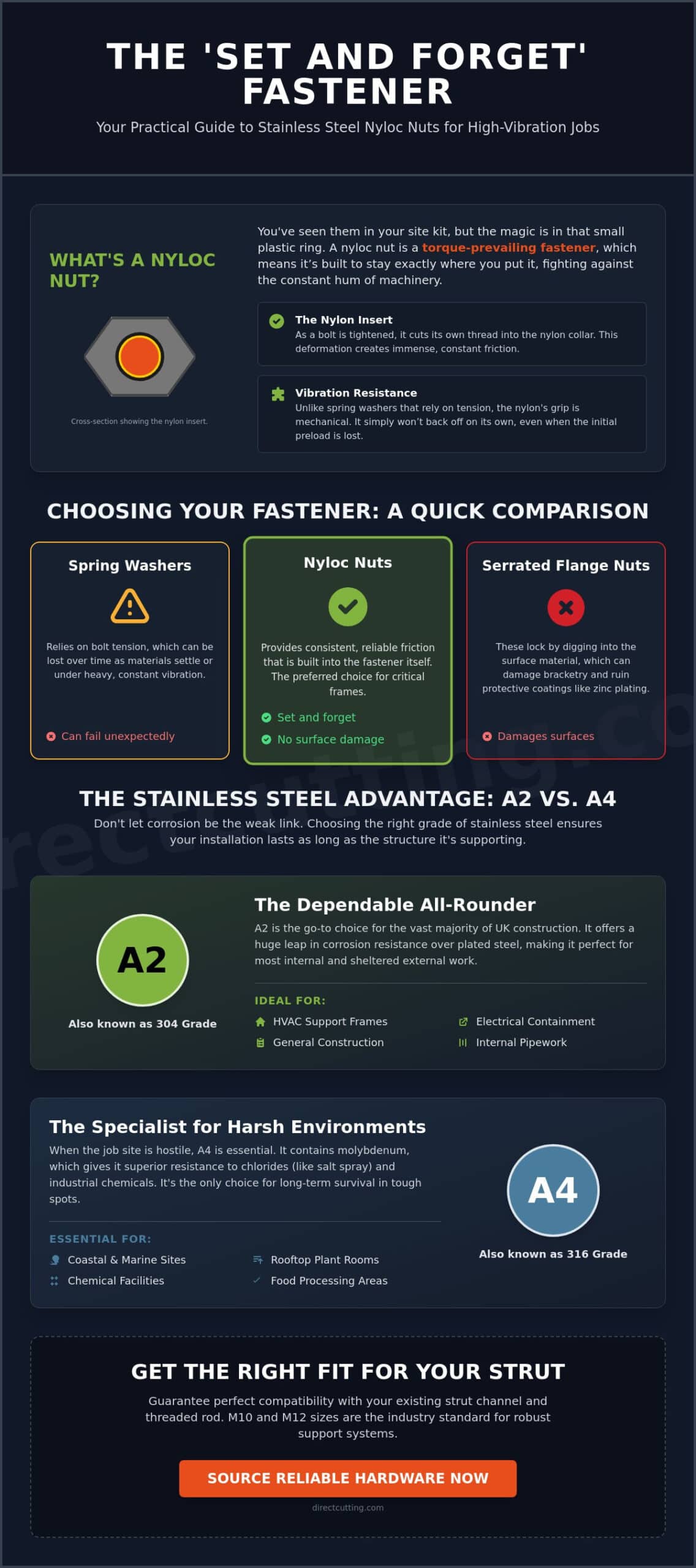
Most site kits have a few of these knocking around, but many people don't realise how much engineering is packed into that small plastic ring. A nyloc nut is essentially a torque-prevailing fastener; it's designed to stay exactly where you put it.
Unlike a standard nut that spins freely once the tension is gone, these require a wrench for every single turn. It's a small detail that makes a massive difference when you're working on a vibrating plant room floor.
If you're wondering exactly what is a nyloc nut and why it beats a spring washer, it comes down to the captive nylon collar. Whilst spring washers rely on tension that can vanish over time as metal settles, stainless steel nyloc nuts use friction that's built right into the threads. It creates a one-way grip that simply won't back off on its own, even if the bolt loses some of its initial preload.
To better understand this concept, watch this helpful video:
The magic happens when the bolt thread hits that nylon collar. Because the nylon isn't pre-threaded, the bolt has to force its way through, deforming the plastic as it goes. This creates a massive amount of friction without damaging the metal thread.
It's a clever design that handles thermal expansion well too. When the metal expands or contracts, that nylon insert moves with it, keeping the grip constant. Just remember that whilst they can be used more than once, the locking power drops every time the nylon is "cut" by a bolt. For critical strut channel frames, always use a fresh nut.
Ask any HVAC installer about their biggest pet peeve, and they'll probably mention site recalls for loose brackets. Standard zinc plated nuts are fine for some jobs, but they can't always handle the constant hum of a pump or a fan.
Using stainless steel nyloc nuts gives you peace of mind during those final site inspections. You aren't just finishing a job; you're ensuring that the support system outlasts the equipment it's holding up.
It's a small upfront cost that saves hours of maintenance work and prevents the risk of a frame failing in a busy corridor. Here is a quick comparison of why they are the preferred choice:
Spring washers: Rely on tension that can fail if the metal settles or vibrates heavily.
Serrated flange nuts: Can damage the surface of your bracketry or protective coatings.
Nyloc nuts: Provide consistent friction without surface damage or reliance on bolt tension.
If you've ever had to replace a rusted-out bracket on a rainy rooftop in Birmingham, you already know that "cheap" hardware often ends up being the most expensive part of the job. It's a classic false economy.
Whilst zinc plated nuts serve a purpose in bone-dry, internal environments, they simply can't hold their own against the relentless damp of the British climate. Choosing stainless steel nyloc nuts ensures that your installation remains a permanent fixture rather than a maintenance headache waiting to happen.
Even high-level fastener reliability standards emphasise that selecting the right material is the foundation of any secure system. It isn't just about preventing rust streaks on the wall; it's about ensuring the threads don't seize or weaken over time. When the metal stays clean, the nylon insert stays effective.
A2 stainless steel, often referred to as 304 grade, is the standard choice for the vast majority of UK construction projects. It offers a massive jump in corrosion resistance compared to galvanised alternatives.
If you're installing HVAC supports or electrical containment in a typical office block or retail unit, A2 is your best friend. It handles condensation and occasional outdoor exposure without breaking a sweat. It's the sensible middle ground that balances cost with long-term durability for most indoor pipework.
Sometimes the job site is a bit more hostile. If you're working on a rooftop plant in a coastal town like Brighton or inside a chemical processing facility, A2 might not cut it. This is where A4 stainless steel (316 grade) comes into play.
It contains added molybdenum, which gives it a specific resistance to chlorides and industrial acids. It's often called "Marine Grade" for a reason. It won't pit or tea-stain when exposed to salt spray or heavy industrial pollution.
When you're sourcing these, remember to match your hardware properly. If you've ordered threaded rod in A4 stainless, your nuts must match perfectly. Mixing grades can lead to galvanic corrosion, which defeats the point of using premium materials in the first place.
You can find the right grade for your next site visit amongst our channel bracketry and fixings range. It's about having the confidence that your support system will still be standing strong ten years from now.
Vibration isn't just a background noise you learn to ignore on a job site; it is a physical force that works against your tools every second the power is on. If you've ever stood in a plant room, you've felt that low-frequency thrum in the floor.
That energy has to go somewhere, and usually, it travels straight into your fixings. Standard nuts rely almost entirely on the tension between the threads to stay put, but vibration creates tiny "micro-slips" that eventually allow the nut to back off completely.
Using stainless steel nyloc nuts is the most practical way to combat this mechanical fatigue. The nylon insert acts as a dampener, absorbing those micro-vibrations whilst providing a constant grip that doesn't rely on the bolt being under permanent tension.
This is particularly vital for trapeze brackets tucked away in ceiling voids or behind ductwork. When you can't physically see the hardware, you need to know it isn't slowly unscrewing itself above a high-traffic office or a busy warehouse floor.
Rooftop installations are particularly brutal on fasteners. An Air Handling Unit (AHU) creates its own mechanical rhythm, but it's also subjected to wind loading that can buffet the entire support frame.
From a business perspective, the logic is simple. A nyloc nut costs pennies more than a standard hex nut, but a return site visit costs a fortune in fuel, labour, and lost time. If a client calls you back because their pipework is rattling or a bracket has sagged, your professional reputation takes a hit.
It suggests the job wasn't done right the first time. We believe in sensible pricing for hardware because it allows tradespeople to use the best parts for the job without blowing the budget. Investing in vibration-proof fixings now prevents the headache of "re-tightening" tours later, keeping your profit margins intact and your customers happy.
Reputation: Secure fixings mean fewer complaints and no "rattle" call-outs.
Safety: Prevents catastrophic failure in areas where heavy equipment is suspended over people.
Efficiency: Eliminates the need for secondary locking measures like messy thread-locking compounds.
Choosing the right diameter for your fixings is about more than just making sure the hole is big enough. If you've ever tried to force an M12 bolt through a bracket designed for M10, you'll know the frustration of a wasted trip to the van.
In the UK, we almost exclusively stick to standard metric coarse threads for commercial installations. This means your stainless steel nyloc nuts will be perfectly compatible with the vast majority of threaded rod and hex head screws found on site. It's a simple system that works, provided you match the scale to the load.
When you're building a frame using strut channel, the nut is only half the story. You also need to consider the surface area. Using square plate washers alongside your nylocs is a standard requirement for most industrial specs.
The washer spreads the load across the face of the channel, whilst the nyloc ensures that once that load is set, it stays there. It's the combination of these two parts that creates a truly rigid support system.
M10 is the undisputed king of the site. It is the go-to size for standard 41x41 strut frames, providing the perfect balance between weight and shear strength. However, when you're dealing with heavy-duty pipe supports or large-scale cable management, M12 becomes the necessary choice.
You'll often find that if you're fixing into metal decking, you'll be using nyloc nuts in conjunction with wedge nuts to create a secure anchor point that won't vibrate loose from the floor above.
It sounds obvious, but you can't install these by hand. Because of that internal nylon collar, you'll need a spanner or a socket for every turn. A common rule of thumb amongst experienced fitters is the "two-thread rule." You want at least two full threads of the bolt protruding through the top of the nylon insert.
This ensures the locking mechanism is fully engaged and doing its job. Just a quick warning: don't get over-excited with the high-speed impact driver. If you run them in too fast, the friction can generate enough heat to actually melt the nylon insert before it's even tightened. Slow and steady is the way to go for a permanent fix.
Ready to stock up for your next project? You can source a full range of compatible stainless steel nyloc nuts and fixings to match your site requirements.
Procurement shouldn't be the slowest part of your project. We've all been on sites where the hardware looks like a lucky dip of rusted zinc and mismatched threads. It's a mess.
Using stainless steel nyloc nuts from a supplier that actually understands the technical demands of HVAC and electrical work changes the game completely. It isn't just about buying a bag of nuts; it's about ensuring every part of your support frame is compatible and built to last. When you're standing on a ladder, you need to know the parts in your hand are going to fit the first time.
Dodgy site work usually starts with a poor procurement list. If you're using cheap, non-locking nuts on a vibrating pipe run, you're basically waiting for a failure to happen. It's a reputation killer.
We focus on what matters to tradespeople: speed, compatibility, and sensible pricing. One of the biggest drains on your time is prepping materials on-site. Why waste half an hour cutting and deburring threaded rod in the back of a van?
That's why we offer pre-cut lengths of strut and rod. When your rod arrives ready to go and your stainless steel nyloc nuts fit perfectly every time, you can get off the site faster and move on to the next task. It's a no-nonsense approach to industrial supply that respects your bottom line and your schedule.
Reliability depends on the whole system, not just a single bolt. As we've discussed earlier, matching your stainless nuts with the correct grade of stainless rod is the only way to prevent corrosion. It's a simple rule, but it's one that gets ignored far too often.
Whilst you're sourcing your fasteners, it's worth looking at our full cable management range to ensure your trays and brackets are just as resilient as your fixings. A chain is only as strong as its weakest link, and your support frame is no different.
Don't settle for "near enough" when you can have hardware that's built for the job. You can browse our full selection of stainless steel nyloc nuts and site fixings today to get your next installation sorted properly.
It's about doing the job once and doing it right. After all, the best hardware is the kind you never have to think about again once the tools are back in the van.
Building a support system that stays put isn't rocket science, but it does require the right gear. We've seen how that small nylon insert stops vibration in its tracks and why choosing the right stainless grade prevents your hard work from rusting away.
Honestly, it's about the confidence that comes with a "set and forget" installation. You don't want to be the person tightening bolts on a rattling AHU six months after the job is signed off.
By using stainless steel nyloc nuts, you're choosing a permanent solution over a temporary fix. It's a small change that makes a massive impact on the durability of your HVAC or electrical containment systems.
We're here to help you get it right with Unistrut Compatible hardware and sensible trade pricing that keeps your margins healthy. As a specialist UK supplier, we understand that you need parts that work together without the fuss.
Ready to upgrade your site kit? Browse our range of professional nyloc nuts and support fixings and get your next project secured for the long haul. You've got the skills to build it, so make sure you've got the hardware to keep it there.
You can technically reuse them, but it isn't recommended for any critical or structural joint.
The nylon insert deforms to the shape of the bolt thread during the first installation, which means the locking torque drops significantly every time the nut is removed and refitted. For a secure industrial frame, it's always best to use a new nut to ensure the friction remains at its peak levels.
The main difference is the level of corrosion resistance. A2 stainless is the standard choice for most UK building sites and internal HVAC jobs where moisture is a minor concern.
If you're working on a coastal site, a water treatment plant, or a chemical facility, you'll need A4 grade. A4 contains molybdenum, which stops salt spray and industrial acids from eating into the metal over time.
No special kit is required, just your standard spanners or socket sets. You'll notice immediately that you can't spin these on with your fingers like a standard hex nut.
The resistance you feel is the nylon insert doing its job; you'll need a tool for every turn from the moment the bolt hits the nylon until the nut is fully seated and tightened.
Standard stainless steel nyloc nuts are usually rated for temperatures between -40°C and +120°C. Beyond the 120°C mark, the nylon insert starts to soften and can eventually melt, which causes the locking mechanism to fail.
If you're working on high-pressure steam pipes or engine exhausts where heat exceeds this limit, you should look for an all-metal locking nut instead.
That ring is designed to create what tradespeople call "prevailing torque." As the bolt enters the collar, it forces its way through the nylon, which deforms to create a tight, friction-based grip around the threads.
This interference fit stops the nut from spinning loose when the machinery starts thrumming or the wind picks up on a rooftop installation.
In most vibration-heavy scenarios, they're a much more reliable choice. Lock washers rely on the tension of the bolt to stay effective, but if that tension drops even slightly, the washer can fail.
A nyloc nut provides consistent friction regardless of the bolt's preload. It's a more dependable "set and forget" solution that won't damage the surface of your brackets or tray.
It will physically fit, but it's a poor choice for long-term durability. Mixing different metals often leads to galvanic corrosion, which can cause the nut to seize or the rod to weaken prematurely.
To get the full benefit of stainless steel nyloc nuts, you should always match them with stainless steel rods and washers to ensure the whole system lasts.
The most common standard you'll encounter in the UK is DIN 985. This refers to the standard "thin" type of nylon insert nut that fits almost all commercial bracketry and strut applications.
If your project specification requires a "heavy" nut with a taller profile and more thread engagement, you might see DIN 982 mentioned, but for most HVAC and electrical jobs, DIN 985 is the go-to.

Article by
Direct Cutting Editorial Team
The Direct Cutting Editorial Team creates practical guides for tradespeople, contractors, installers, and DIY buyers who need clear advice on strut channel, threaded rod, fixings, brackets, and cable tray accessories. Our articles are based on real customer questions, product knowledge, supplier information, and everyday use cases from people ordering cut-to-length strut channel and related support system products across the UK. Each guide is reviewed before publication to help make sure the information is useful, accurate, and easy to understand.