✓
No Minimum Order
✓
Friendly Service
✓ Fast Nationwide Delivery
Paying a massive premium just for a fancy logo on a piece of steel doesn't make your pipework any more secure.
It is even harder to swallow when your chosen universal beam clamp supplier is passing on steel tariffs that are set to double to 50% this July.
You've probably stood on a site with a half-finished HVAC install, waiting for a delivery that's three days late.
Or perhaps you're staring at clamps that simply won't bite into your existing strut channel.
It's a common headache for tradespeople who just want gear that works without the corporate mark-up.
Honestly, once you realise that technical specs matter more than brand names, finding a partner shouldn't feel like a choice between project safety and your profit margin.
I'm going to show you how to source hardware that balances technical reliability with sensible trade pricing.
Here's where it gets interesting.
We'll look at ensuring Unistrut compatibility, meeting the latest BS EN 13155:2020+A1:2025 standards, and dodging the supply chain delays that kill your momentum.
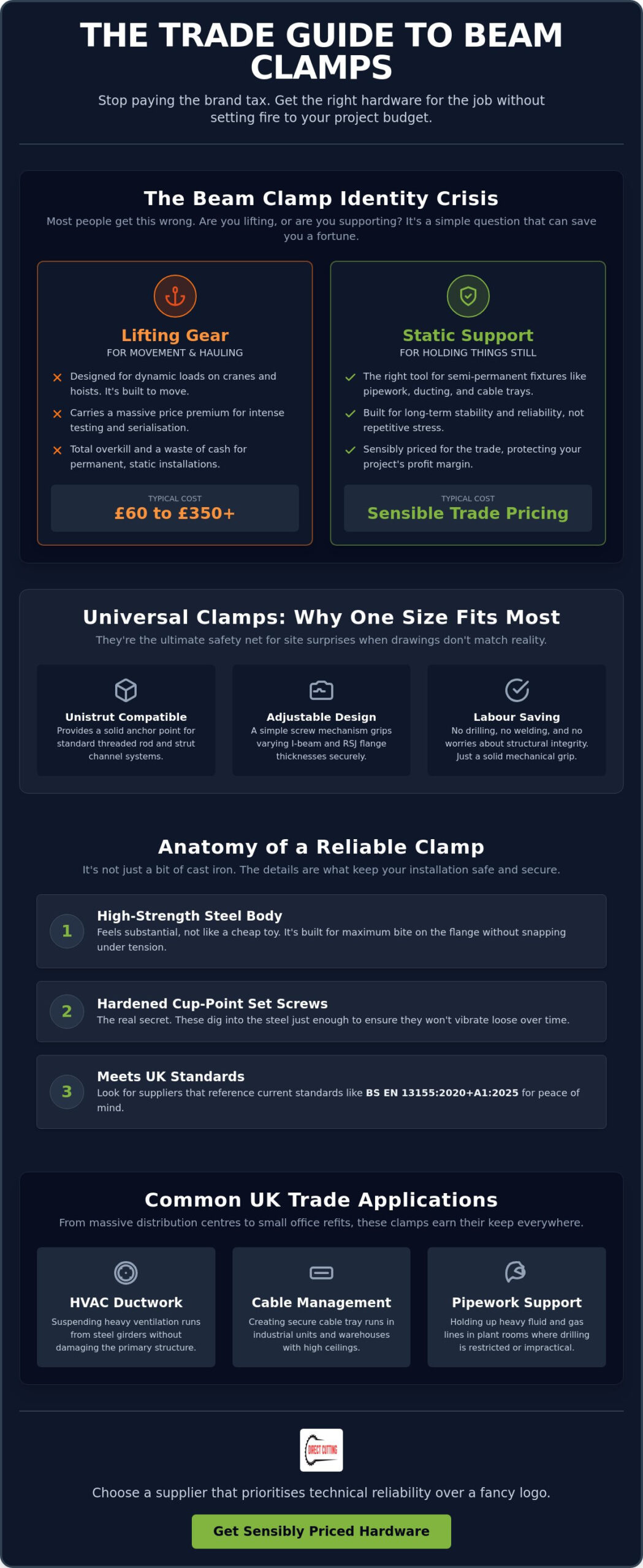
Honestly, most people get this wrong the first time they start sourcing hardware. You type a quick search for a clamp and half the results show these massive, heavy-duty orange claws meant for a crane or a hoist. Those are lifting clamps. They are designed for movement; they grip a beam so a machine can haul it across a warehouse or up a few storeys. If you are an installer, that is almost certainly not what you are looking for.
What you actually need is a semi-permanent hardware device to hold up a run of pipework or a length of strut. This is where a specialist universal beam clamp supplier becomes your best friend. They understand that you need static support, not a piece of heavy machinery. Universal beam clamps bridge the gap for most static loads by gripping the flange of an I-beam or RSJ to provide a solid anchor point for a threaded rod.
It is a simple distinction, but getting it wrong is a quick way to set fire to your project budget. Lifting gear is built for motion and extreme, repetitive stress. Static support is built for stability and long-term reliability. One stays put; the other is always on the move.
Lifting-certified gear carries a massive price premium. You are paying for intense testing, individual serial numbers, and certifications that just aren't necessary for hanging a bit of ductwork. Static supports require different safety factors and testing protocols. For example, a 5-tonne lifting clamp can cost anywhere from £61 to over £350 depending on the spec, but using that level of kit for a permanent fixture is a total waste of cash.
Using the wrong tool for the job is an expensive mistake that goes beyond the initial purchase. If you over-spec with lifting gear, you're eating into your margins for no technical gain. Conversely, trying to use a basic static clamp for a dynamic lifting job is a massive safety risk. Choosing a universal beam clamp supplier that understands the UK trade ensures you get the right rating for the right application without the "brand tax" of lifting specialists.
In the UK, we see these used everywhere from massive new-build distribution centres to small office refits. The goal is almost always the same: finding a way to hang kit without drilling into the primary steelwork. Here are the most common spots where these clamps earn their keep:
By using a clamp that bites onto the flange, you save hours of labour. No drilling, no welding, and no structural integrity worries. It is just a straightforward, mechanical grip that gets the job done.
Here is where it gets interesting for installers who have spent too many hours rummaging through the back of a van for the right size bracket. Most UK steelwork follows standard I-beam and RSJ profiles, but the flange thickness can vary wildly from one floor to the next. Carrying a specific clip for every possible millimetre of steel is a logistical nightmare that stalls progress.
A universal design adjusts to these varying thicknesses with a simple screw mechanism. It eliminates the need for carrying ten different specialist clips that you might never use again. When you work with a reliable universal beam clamp supplier, you are essentially buying a safety net for those moments when the site drawings don't quite match the reality of the steel already in the air.
Understanding different Types of Steel Connections is vital for structural engineers, but on the ground, you just need a grip that won't slip. These clamps are the utility players of the mechanical support world. They handle the vast majority of static loads without requiring a bespoke solution for every girder.
A decent clamp isn't just a bit of cast iron. It starts with high-strength steel bodies designed for maximum bite on the flange. You want something that feels substantial in your hand, not like a cheap toy that will snap under the first sign of tension.
The real secret is in the hardened cup-point set screws. These are designed to dig into the steel slightly, ensuring they won't vibrate loose over time as the building settles or the HVAC system kicks in. Finally, everything should have heavy zinc plating. It is the only way to resist the damp British weather and the condensation that naturally forms in unheated industrial units.
Finding a clamp that plays well with your strut channel is usually the biggest hurdle for a smooth install. Most universal clamps feature a threaded hole in the base, specifically designed to take an M10 or M12 threaded rod. This allows you to drop a trapeze bracket or a single pipe support directly from the beam in seconds.
You also need to ensure the mouth opening is wide enough to handle your specific beam flange. Most standard universal clamps handle up to 20mm or 25mm flanges, which covers about 90% of what you'll find on a typical UK site. If you want to simplify your next install and stop over-ordering specialist parts, checking out a trusted universal beam clamp supplier is the best place to start.
It's about making your life easier on site. You don't need a thousand options; you just need one that works every single time.
Specialist clamps are brilliant on paper. They fit a specific flange like a glove, but they're completely unforgiving. We see it all the time on UK sites; a slight change in the steelwork from the original drawings can stall a whole crew of electricians or HVAC installers for days. If the steel contractor swaps an RSJ for a thicker beam, your bespoke clips become useless bits of scrap metal.
That is where a reliable universal beam clamp supplier saves your skin. Instead of waiting for a niche fitting to arrive, you have a component that adjusts on the fly. It is the ultimate safety net for those inevitable site surprises. Honestly, having a box of universal gear in the van is just good insurance against poor communication between trades.
If your project involves actual hoisting or moving loads, you must strictly follow the Lifting Operations and Lifting Equipment Regulations 1998 (LOLER). However, for the bread and butter of static mechanical supports, universal reliability usually wins. It keeps the job moving when the site conditions decide to throw you a curveball.
There are certain scenarios where opting for a universal design is the only logical move. If you are installing standardised trapeze brackets for cable management, you want a fitting that works across the entire floor. It simplifies the whole procurement process.
It is also a lifesaver on projects with varying beam sizes across different levels. Instead of managing a complex inventory of five different specialist clips, you just stock one. Having a 'just in case' supply of these fittings means your team isn't sitting around drinking tea while waiting for a single box of hardware to arrive from a merchant three towns over.
Vibration is the silent killer of support systems. In plant rooms or near heavy HVAC machinery, the constant hum can eventually cause standard fixings to back out. This is why you should always pair your rod with nyloc nuts. They provide a mechanical lock that standard nuts simply can't match.
The set screw on the clamp does the heavy lifting, but the nut keeps everything under tension. It is a small addition that prevents a massive failure down the line. If you want to understand more about securing your fixings against movement, check out our Nyloc Nuts Guide for the full breakdown.
It's about building something that stays built. You don't want a callback six months later because a tray has started to sag due to a loose nut.
Let's be real about the 'brand tax' for a minute. Major manufacturers love to charge you for the name on the box, not just the steel inside. If you're a contractor, every extra pound you pay for a logo is a pound coming out of your profit margin. Reliability comes from the material specification and the quality of the zinc plating, not the marketing budget of a global corporation.
A good universal beam clamp supplier knows their M10 from their M12 without having to look it up in a glossy brochure. They understand that on a Tuesday afternoon on a site in Birmingham, you don't need a fancy PDF. You need hardware that fits the first time. Honestly, the steel doesn't know what brand it is once it's bolted to a beam; it only knows if it's strong enough to hold the load.
Direct trade supply is the only way to keep your costs down. It cuts out the middleman who adds zero value but plenty of markup to every single box of fixings. You also need stock levels that actually exist in a UK warehouse right now.
There's nothing worse than being told a part is "in stock" only to find out it's currently on a container ship in the middle of the ocean. Look for technical knowledge that goes beyond just reciting a part number from a screen. A supplier who understands that an M10 rod is the standard for most light-to-medium HVAC runs, whilst M12 is reserved for the heavier pipework, is a supplier worth keeping. For a deeper dive into choosing the right beam clamp fixings for UK steelwork, including LOLER and PUWER compliance and hot-dip galvanised coating specifications, our professional guide covers everything you need to know.
You don't always need the branded version to get the job done correctly. Focus on the fitment and the load ratings instead of the logos. If a clamp is compatible with your Strut Channel, it's the right tool for the job.
Compatibility is the primary signature of a smart procurement strategy. It allows you to mix and match components to get the best value without compromising on the safety of the installation. If you want to stop overpaying for big-name brands and start protecting your margins, take a look at our beam clamps and fixings to see how much you can save on your next project.
It's about making a pragmatic choice. You want hardware that does the job, arrives on time, and doesn't break the bank.
Planning ahead saves you from the painful, budget-stripping sting of a local merchant's markup.
There is nothing quite like the frustration of being three clamps short on a Friday afternoon and having to pay double the trade price just to finish a floor. Bulk buying your essential hardware is a total no-brainer if you want to keep your project margins where they belong. When you work with a direct universal beam clamp supplier, you can afford to keep a decent stock in the workshop rather than buying hand-to-mouth for every individual job.
Honestly, check your quantities twice before the van even leaves the yard. The right hardware makes a difficult, high-level install feel like a walk in the park. It is about having the confidence that every part in your bag is compatible and ready to bite into the steel without any fuss.
Running out of parts mid-job is the ultimate productivity killer. You end up burning fuel and time just to pick up a handful of fixings you should have had in the first place. A little bit of foresight on the procurement side goes a long way when you're standing on a scissor lift twenty feet in the air.
You need more than just the clamps to get a run of tray or pipework straight and secure. Always keep a healthy supply of square plate washers on hand to distribute the load across your strut channel properly. They prevent the channel from deforming under tension and ensure a professional finish that will pass any site inspection.
Make sure you have enough threaded rod to handle the drop height, plus a bit extra for site adjustments. It sounds basic, but having the correct spanners for those hardened set screws is the difference between a secure bite and a rounded-off mess. If you're using M10 or M12 rods, ensure your nuts and washers are all zinc-plated to match the rest of your support system. If you want to skip the drilling entirely and get a rock-solid beam clamp for threaded rod setup secured in seconds, our no-drill guide covers exactly how to achieve a vibration-resistant install without burning through expensive drill bits.
A support system is only ever as strong as its weakest link. It doesn't matter how expensive your cable tray or pipework is if the clamps holding it to the beam are flimsy or poorly fitted. Don't skimp on the very components that hold the whole project up in the air. Choosing a universal beam clamp supplier that values technical fit over flashy branding ensures your site stays safe and your profit stays in your pocket.
Ready to get started on your next project? You can view our range of beam clamps and fixings to get your kit sorted today. It's the simplest way to ensure your next install is as efficient as possible.
Honestly, once you stop paying the "brand tax" for a fancy logo, your project budgets start looking a lot healthier. You now know that static support doesn't require the same eye-watering investment as lifting gear; it just requires the right specification. It's about the right gear.
It's about choosing a universal beam clamp supplier that understands the gritty reality of a UK construction site. You need hardware that is Unistrut compatible and ready to work as hard as your crew does. No more waiting. Why overpay at a local merchant when you can get exactly what you need delivered nationally?
We focus on sensible trade pricing because we know that technical reliability shouldn't cost the earth. It's time to stop second-guessing your fixings and start building with genuine confidence. Shop our range of professional beam clamps and support hardware to find the perfect fit for your next install. Your future self, standing on a finished site with the job done right and the margins intact, will thank you for it.
A universal beam clamp is a heavy-duty bracket that grips the flange of a steel beam to create a secure hanging point for threaded rod. You'll mostly see them used to support HVAC ducting, cable trays, or heavy pipework without the need for drilling or welding into the building's primary steelwork. It is a massive time-saver on commercial refits that keeps the structural integrity of the girders intact.
You need to measure the thickness of the beam's flange where the clamp will sit. Most universal designs are built to handle a range, often up to 20mm or 25mm thick, which covers the majority of standard UK steelwork. Just ensure the mouth of the clamp is wider than the steel you're biting onto so the set screw can engage properly with the surface.
They are designed to be compatible with all standard strut channel brands found in the UK. Your universal beam clamp supplier will typically provide units with M10 or M12 threaded holes. This allows you to use standard rod to connect the clamp to any Unistrut-style channel without needing bespoke adapters. It is a straightforward system that makes procurement a lot simpler for busy site managers.
Zinc plating is the standard for most indoor trade work, but for anything exposed to the elements, you want a more robust finish. Hot-dip galvanised steel is generally the go-to for outdoor projects. It provides a thicker layer of protection against the relentless British rain and humidity that can quickly corrode standard zinc-plated hardware. For a full breakdown of coating specifications and how a 50-micron hot-dip galvanised beam clamp performs in demanding outdoor environments, our professional guide has the detail you need.
The set screw should be tightened until it is firm against the steel, followed by a quarter to half turn with a spanner. You want the cup point to bite into the flange slightly to prevent any lateral movement. Don't over-tighten it to the point where you risk rounding the head or stripping the threads. A secure, mechanical grip is all that is required for static support.
A safety chain isn't usually a legal requirement for static loads, but it is often specified in high-vibration areas as an extra precaution. If you're hanging gear above a public walkway or near heavy vibrating machinery, a secondary restraint is just good practice. It provides that extra bit of peace of mind for the installer and the building owner alike.
The capacity depends on the manufacturer's specific rating for that particular model. Whilst many trade-grade clamps are rated for static loads between 250kg and 500kg, you must always verify the Safe Working Load stamped on the hardware. It is the only way to be certain. Never take a gamble on the weight capacity of your support system, especially when it is hanging over a busy site floor.

Article by
Direct Cutting Editorial Team
The Direct Cutting Editorial Team creates practical guides for tradespeople, contractors, installers, and DIY buyers who need clear advice on strut channel, threaded rod, fixings, brackets, and cable tray accessories. Our articles are based on real customer questions, product knowledge, supplier information, and everyday use cases from people ordering cut-to-length strut channel and related support system products across the UK. Each guide is reviewed before publication to help ensure the information is useful, accurate, and easy to understand.